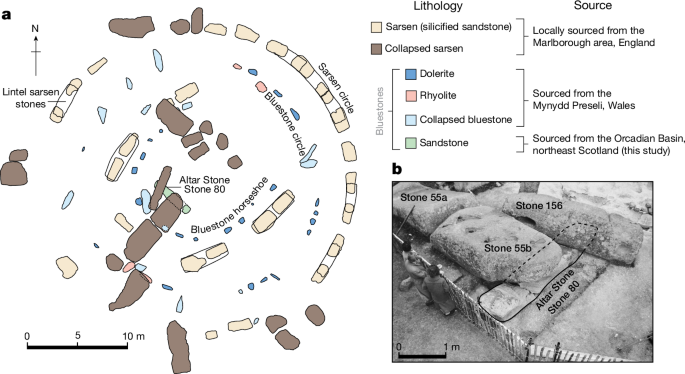
Stonehenge stands as an enduring testament to the ingenuity and ambition of our Neolithic ancestors. Its colossal sarsen stones and distinctive bluestones have captivated historians, archaeologists, and curious minds for centuries. While much focus rightly falls on the sheer architectural feat, an often-overlooked marvel lies at its very heart: the Altar Stone. This single, monumental slab holds a secret far grander than its immediate neighbours, telling an incredible tale of an epic stonehenge journey scotland, spanning a staggering 466 miles across ancient landscapes. This article delves into the fascinating origins of the Altar Stone, unraveling the logistical challenges and the profound motivations behind its astonishing pilgrimage from the wilds of Scotland to the Salisbury Plain.
The Heart of Stonehenge: A Stone with a Story
Positioned centrally within the monument's inner horseshoe of bluestones, the Altar Stone is perhaps the most enigmatic of Stonehenge's megaliths. Unlike the towering sarsen stones, which are believed to have been sourced from Marlborough Downs just 19 miles (30 kilometers) away, or even the famous bluestones, which undertook a considerable journey from the Preseli Hills in Wales, the Altar Stone boasts an origin that truly boggles the modern mind. It is the largest of what archaeologists classify as the "non-sarsen" stones, distinguished by its unique geological composition. Rather than the igneous dolerite of the bluestones or the silcrete of the sarsens, the Altar Stone is believed to be a type of sandstone, a characteristic that became key in tracing its astonishing distant home.
Its strategic placement suggests immense symbolic importance. While its precise function remains a subject of debate – was it an altar for rituals, a place of sacrifice, or a central marker for astronomical alignments? – its very presence, combined with its extraordinary provenance, elevates it to a status beyond mere building material. It is a focal point, a silent witness to millennia of human activity, and a powerful symbol of the effort and meaning invested in this sacred site.
Tracing the Unbelievable Journey: 466 Miles from Scotland
The revelation that Stonehenge's Altar Stone originated in Scotland is one of the most exciting geological and archaeological discoveries associated with the monument. While the local sarsens presented a significant logistical challenge, and the bluestones' transport from Wales was already considered a Herculean task, the notion of a stone traveling 466 miles from Scotland to Stonehenge reshapes our understanding of Neolithic capabilities and societal structures. Modern scientific analysis, primarily through petrographic and geochemical fingerprinting of the stone, has allowed researchers to match its unique characteristics to geological outcrops found deep within Scotland.
Imagine the scene: thousands of years ago, long before paved roads or wheeled vehicles, a community or a collective of communities embarked on an undertaking that seems almost impossible even today. The distance of 466 miles is roughly equivalent to traveling from London to Edinburgh. For Neolithic people, without the aid of modern technology, this wasn't just a journey; it was an odyssey. The precise Scottish location is still subject to ongoing research, but the general consensus points north, far beyond the familiar English and Welsh landscapes. This makes the stonehenge journey scotland one of the most profound examples of long-distance megalithic transport known anywhere in the world.
Neolithic Engineering Marvel: How Was It Moved?
The question of "how" a stone of such magnitude – weighing potentially several tons – could be transported across such a vast distance has puzzled experts for decades. While the exact methods remain speculative, archaeological and experimental archaeology offer compelling theories:
- Land Transport: For shorter distances, or sections of the journey over land, methods likely involved ingenious combinations of brute force and simple machines. Wooden rollers placed beneath the stone, moved incrementally forward, would have facilitated movement over relatively flat terrain. Sledges, possibly lubricated with animal fat or water, could have been dragged over dedicated pathways. The sheer manpower required for this would have been immense, involving hundreds, if not thousands, of individuals working in highly coordinated teams.
- Water Transport: Given the extensive distance and the geography of ancient Britain, a significant portion of the Altar Stone's journey must have involved water. Rivers and coastal routes would have offered a far more efficient, albeit still challenging, method of transport. Large rafts, constructed from timber and buoyed by inflated animal skins or hollowed logs, could have been used to float the stone along rivers and potentially even across coastal waters. This would have required skilled boat-building, navigation, and an intimate understanding of tides and currents.
The logistics alone highlight an unprecedented level of planning, organization, and social cohesion. It wasn't merely about moving a heavy object; it involved sourcing materials for rafts and rollers, feeding and sheltering a large workforce over extended periods, and navigating diverse and often challenging terrain. The journey would have traversed numerous tribal territories, suggesting either widespread collaboration, tribute, or a deeply ingrained shared cultural purpose that transcended local boundaries. The fact that they successfully completed this 466-mile Scottish journey of Stonehenge's Altar Stone stands as a testament to their extraordinary resolve and collective ingenuity.
The Enigma of Motivation: Why Scotland?
Beyond the "how," perhaps the most profound question is "why?" Why would Neolithic communities expend such immense resources and effort to bring a single stone from so far north? Several theories attempt to answer this:
- Spiritual Significance: The stone itself may have possessed a particular spiritual or mystical quality. Perhaps its geological properties, its colour, or its source location in Scotland held specific meaning, connecting it to ancestral lands, powerful deities, or cosmic forces.
- Symbol of Power and Unity: The act of acquiring and transporting such a stone could have been a powerful demonstration of the prestige, wealth, and influence of the communities who built Stonehenge. It might have served as a symbol of unity, bringing together disparate groups under a common, monumental project.
- Commemoration of a Homeland: It's possible that the builders, or at least some key figures among them, originated from Scotland. Bringing a piece of their ancestral homeland to this new, significant spiritual centre could have served as a profound act of remembrance or connection.
- Curative or Magical Properties: Some theories surrounding the bluestones suggest they were believed to have healing properties. While less commonly applied to the Altar Stone, it's not inconceivable that this unique stone from a distant land was thought to possess special powers.
Regardless of the exact reason, the deliberate choice to undertake such a monumental stonehenge journey scotland underscores the deep symbolic and cultural importance of the Altar Stone. It was not merely a construction material; it was a sacred relic, a piece of a distant, revered landscape brought to the spiritual heart of ancient Britain.
Lessons from the Past: Practical Insights
The incredible story of the Altar Stone's journey offers more than just archaeological wonder; it provides valuable insights applicable even today:
- Visionary Project Management: The scale of this project demonstrates exceptional long-term planning, resource allocation, and sustained effort across generations. Modern large-scale projects could learn from this ancient example of collective ambition.
- Ingenuity with Limited Resources: The Neolithic people achieved extraordinary feats using only natural materials and rudimentary tools. This highlights the power of creative problem-solving and making the most of available resources.
- The Power of Collaboration: Such an undertaking would have required unprecedented cooperation among numerous communities, transcending potential rivalries for a shared goal. It's a testament to the unifying power of belief and purpose.
- Understanding Geological Provenance: The scientific methods used to trace the stone's origin highlight the importance of interdisciplinary research – geology, archaeology, and even mythology working together to unlock ancient secrets.
Beyond the Altar Stone: The Broader Context of Stonehenge's Construction
While the Altar Stone's incredible provenance from Scotland takes centre stage in this discussion, it's crucial to remember it's part of an even larger, more complex story. Stonehenge was not built in a single phase; its construction spanned over a thousand years, involving multiple stages and the transport of various types of stone from different locations.
The smaller bluestones, weighing up to 4 tons each, made a journey of approximately 150-240 miles (240-380 km) from the Preseli Hills in Wales. The massive sarsen stones, some weighing up to 50 tons, were quarried a "mere" 19 miles (30 km) away. Yet, it is the Altar Stone's 466-mile trek that truly sets it apart, underscoring that for the builders of Stonehenge, distance was not an insurmountable barrier when the purpose was profound. The stonehenge journey scotland of this one stone adds another layer of awe to an already astonishing ancient monument, solidifying its status as one of humanity's most ambitious and enigmatic prehistoric achievements.
The Stonehenge Altar Stone represents not just a piece of rock, but a saga of human endeavour, belief, and unparalleled determination. Its epic 466-mile journey from Scotland to the Salisbury Plain is a powerful reminder of the sophisticated organization, engineering prowess, and deep spiritual connections that characterized Neolithic societies. It urges us to look beyond the standing stones and contemplate the incredible stories embedded within each one, especially the quiet, enduring mystery of the stone that traveled halfway across an ancient land to take its place at the very heart of the world's most famous prehistoric monument.